– Begins with an understanding of its students as a whole person, who should learn to recognize and love that which is good, true, and beautiful.
-Aims to develop in its students the ability to learn anything for themselves by way of studying the Arts and the Sciences.
– Is guided by a general progression of skills to be developed, but follows the individual nature of each student as they journey through the five Stages of Experience.
What Is Meant By:
Whole Person Education
Christ instructs us to love the Lord, your God with all your Heart, Soul, Mind, and Strength. Each of these aspects combined creates the whole person.
A Classical Education in this framework is one that demonstrates a heart posture of virtue and devotion to God, nourishes the soul, engages the body, and develops the mind using study of the Arts and the Sciences.
Goodness, Truth, and Beauty
A Classical Education emphasizes virtue and the objective nature of goodness, truth and beauty and aims to train an individual to recognize and love that which is good, true, and beautiful in the world.
The Arts
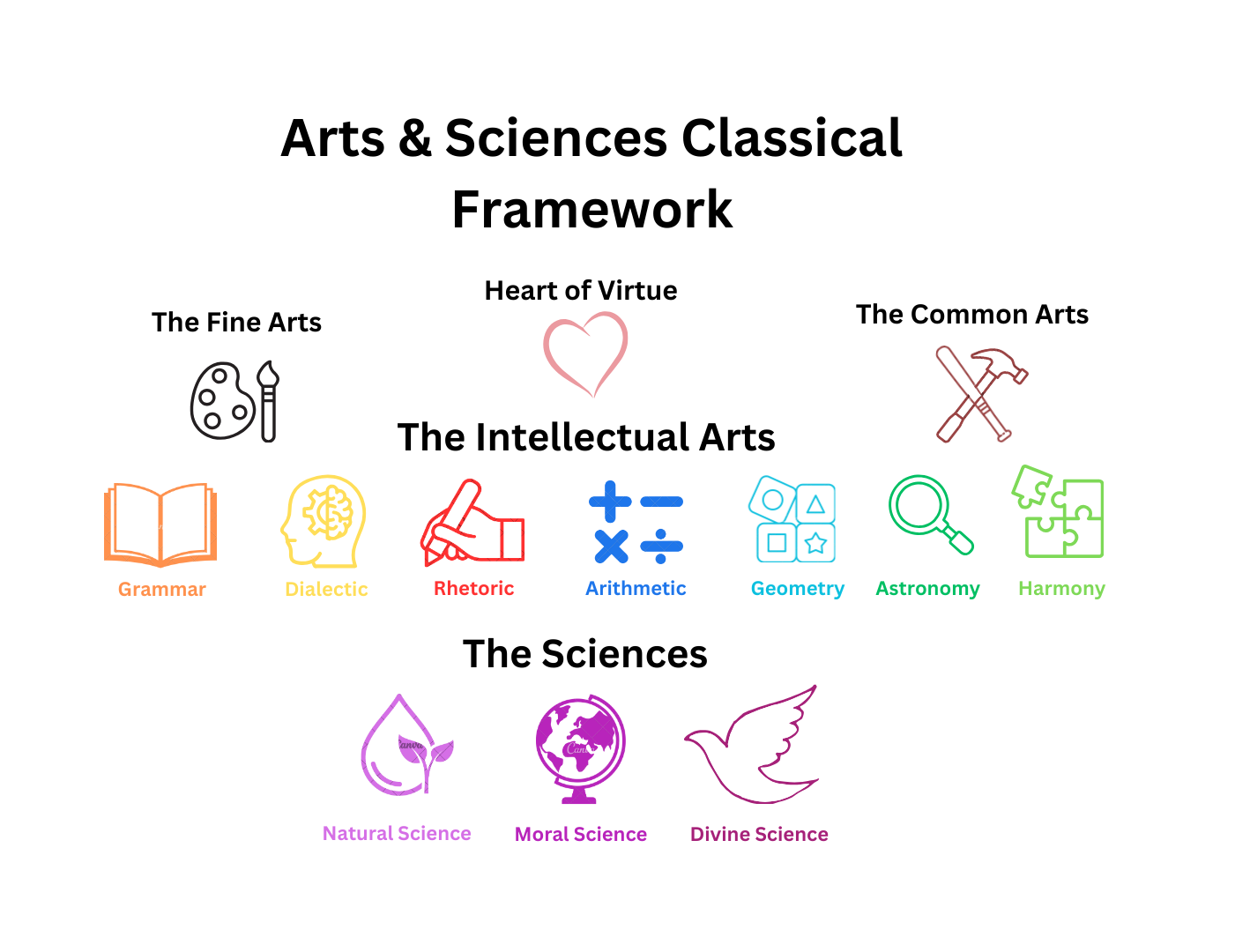
Skills are the things in life we learn to do. An Art is a skill (or set of skills) to which you apply reason in order to create something. There are 3 main categories of arts which align with three of the aspects of a person: Fine Arts (Soul), Intellectual Arts (Mind), and Common Arts (Body). Though we often focus on the Intellectual Arts in schooling, the development of all of these areas together allows for whole person education.
Fine Arts are used to create something beautiful.
Intellectual Arts (Liberal Arts) are used to create a body of knowledge.
Common Arts are used to create something useful.
The Sciences
In the Classical world, the word “Science” just meant “body of knowledge.” While the Arts are what we learn to DO, the sciences are what we learn ABOUT. There are three categories for the Sciences: Natural Science, Moral Science, and Divine Science. These categories inform how we relate to the world around us (Natural), the people around us (Moral) and to God (Divine).
In the Arts and Sciences Framework, the Sciences are best represented by subjects more familiar to us today like history, geography, science, and Theology.
Progression of Skills
All skills build upon each other. Before we learn to read, we learn to put sounds together. Before we learn to put sounds together, we learn to associate sounds with letters. The skills within the Arts are progressive as well. All skills move from learning (direct instruction), to practicing (repeat and refine), to applying (automatic use).
Within the Intellectual Arts, specifically, there are 7 categories of skill sets. Also known as the Liberal Arts, these consist of the Trivium(Language Arts) and the Quadrivium (Mathematical Arts). Within each of these 7 Arts, there is a progression of skills which builds from birth to adulthood.
The Stages of Experience
Because all of life is education, our education in the Arts and Sciences begins at birth. The Arts and Sciences Framework outlines 5 stages through which a student grows. By recognizing the strengths, weaknesses, and goals of each stage, we can plan instruction that is appropriate both to development and skill level. These stages are not rigid ages, but rather tend to blend gradually from one to the next depending on the individual.
God created people in His image, but with unique personalities, talents, interests, and weaknesses. Using a structured framework for education does not mean that education should be standardized apart from consideration of the individual.
While the progression of skills is guided by a certain order, the rate at which those skills develop depends on the student and should not be determined based on age or grade and can even vary from art to art. Parents and Educators should assess a student based on growth within skill sets rather than whether they are “ahead” or “behind” of “grade level.”
Deuteronomy 6:6-7 And these words that I command you today shall be on your heart. Teach them diligently to your children...
Mark 12:30 Love the Lord your God with all your heart, with all your soul, with all your mind, and with all your strength.
Colossians 2:6-7 Therefore, as you received Christ Jesus the Lord, so walk in Him, rooted and built up in Him and established in the faith.